Noise Reduction Windows: Creating Peaceful Homes

Is Traffic Noise Stealing Your Family’s Peace?
Imagine this: You’ve just moved into your beautiful new independent house in Bhubaneswar, Nagpur, or Ranchi. The construction is perfect, interiors are stunning, but there’s one problem you didn’t fully anticipate—the constant traffic noise from the main road nearby.
Honking horns, engine sounds, heavy vehicles rumbling past—the noise penetrates your home, disturbing your children’s sleep, interrupting your work-from-home calls, and preventing your family from truly relaxing in your own space.
Even tier 2 cities now face significant noise pollution. Major roads in Patna, Jamshedpur, and Guwahati experience traffic density approaching metro levels, with noise levels reaching 70-80 decibels—far above the comfortable 40-45 decibels for residential areas.
This guide explains how modern aluminium system windows with acoustic features reduce traffic noise by 35-45 decibels, transforming your home into a peaceful sanctuary.
Understanding Noise and Its Impact
Decibel Scale Perspective:
70-80 dB: Busy traffic, constant honking (outside your window) 60-65 dB: Normal conversation, office environment 40-45 dB: Quiet library, comfortable home environment 30-35 dB: Whisper, ideal bedroom at night
Health Impacts of Continuous Noise:
- Sleep disruption affecting children and elderly
- Increased stress and blood pressure
- Reduced concentration and productivity for work-from-home
- Constant irritability and fatigue
- Difficulty in family conversations
Real Estate Impact: Properties on busy roads in Ranchi or Nagpur often sell 10-15% below comparable quiet-location properties. Quality acoustic windows can recover this value difference.
How Sound Travels Through Windows
Understanding this helps you choose the right solution:
Three Sound Transmission Pathways:
Through the Glass: Sound waves vibrate glass panels, transmitting noise to the interior. Single thin glass offers minimal resistance.
Through the Frame: Aluminium frames vibrate with sound waves, conducting noise through the metal structure into your room.
Through Gaps and Seals: Sound leaks through any air gaps between sash and frame, around hardware, or at corner joints. Even a 1mm gap significantly reduces acoustic performance.
Why Basic Windows Fail:
- Single 5mm glass with minimal mass
- Solid aluminium frames conducting vibrations
- Poor sealing allowing direct sound leakage
- No engineering for acoustic performance
Result: 70 dB outside becomes 55-60 dB inside—still too noisy for comfort.
How Acoustic Aluminium Windows Work
System windows use multiple strategies simultaneously:
- Thermal Break Frame Construction
The same polyamide barriers that block heat also dampen sound vibrations.
How It Works: Sound waves traveling through the exterior aluminium frame hit the polyamide barrier. The different material properties cause sound energy to dissipate rather than transmit through to the interior frame.
Performance: Thermal break frames alone reduce noise transmission by 5-8 decibels compared to standard aluminium.
- Multi-Chamber Frame Design
Modern system profiles have 3-5 internal chambers within the frame.
Acoustic Benefit: These air-filled chambers act as resonance dampers. Sound waves entering the frame structure bounce between chamber walls, losing energy with each reflection.
- Advanced Sealing Systems
Sound leaks through gaps like water through cracks. Perfect sealing is critical.
EPDM Gasket Sealing: High-quality continuous gaskets eliminate air gaps that allow sound leakage. Even tiny gaps drastically reduce acoustic performance.
Multi-Point Locking: 3-7 locking points compress gaskets uniformly along the entire frame perimeter, eliminating sound leakage pathways that single-point locks leave open.
Real-World Impact: Proper sealing alone improves noise reduction by 10-15 decibels compared to poorly sealed windows.
- Double Glazing with Acoustic Optimization
This is the most impactful factor:
Mass Barrier Effect: Two glass panes separated by an air gap create a mass-spring-mass system. Sound vibrates the outer pane, but the air gap prevents transmission to the inner pane.
Optimal Air Gap: 12-16mm air gap provides best acoustic performance for residential applications. Gaps below 10mm or above 20mm reduce effectiveness.
Laminated Acoustic Glass: Special PVB (polyvinyl butyral) interlayer between two glass sheets dampens vibrations. Acoustic laminated glass outperforms regular glass by 3-5 decibels.
Asymmetric Glazing: Using different thickness for outer and inner panes (e.g., 6mm outer, 4mm inner) prevents resonance at specific frequencies, blocking a wider sound spectrum.
Performance Levels Explained
Standard Single Glazing: Noise reduction: 25-28 dB 70 dB outside → 42-45 dB inside Minimal improvement, still noisy
Double Glazing (5mm+12mm+5mm): Noise reduction: 30-35 dB 70 dB outside → 35-40 dB inside Good improvement, comfortable for moderate traffic
Acoustic Double Glazing (6mm laminated+14mm+4mm): Noise reduction: 35-40 dB 70 dB outside → 30-35 dB inside Excellent performance, quiet home environment
Premium Triple Glazing: Noise reduction: 45-50 dB 70 dB outside → 20-25 dB inside Outstanding performance, near-silent interior
Choosing Based on Your Situation
Moderate Traffic Exposure (Bhubaneswar, Ranchi residential areas):
- Double glazing with 12mm air gap
- Thermal break frames
- Multi-point locking
- Investment: ₹1,500-1,800 per sq ft
- Achieves comfortable 35-40 dB reduction
Heavy Traffic Roads (Main roads in Nagpur, Patna, Jamshedpur):
- Acoustic laminated double glazing
- 14-16mm air gap
- Premium sealing systems
- Investment: ₹1,800-2,200 per sq ft
- Achieves excellent 35-42 dB reduction
Extremely Noisy Locations (Highway proximity, Guwahati busy zones):
- Triple glazing or thick acoustic laminated
- Maximum frame depth for added mass
- Casement windows for superior sealing
- Investment: ₹2,200-2,800 per sq ft
- Achieves outstanding 45-50 dB reduction
Window Type Makes a Difference
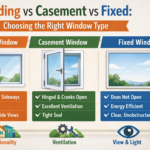
Casement Windows: Best Acoustic Performance
Advantages for noise reduction:
- Compression sealing all around perimeter
- No gaps in closed position
- Multi-point locking ensures perfect seal
- 3-5 dB better performance than sliding
Best for: Bedrooms, study rooms, living rooms facing noisy roads
Sliding Windows: Good with Limitations
Acoustic considerations:
- Small gaps in track system allow some sound leakage
- Only vertical edges sealed (not top/bottom in most designs)
- 2-3 dB lower performance than casement
Can work for: Moderate noise situations, balconies where casement isn’t practical
Fixed Windows: Maximum Performance
Benefits:
- No opening mechanism means perfect sealing
- All four sides permanently sealed
- Can achieve highest acoustic ratings
Limitation: No ventilation, must combine with operable windows
Room-by-Room Strategy
Master Bedroom (Most Critical): Acoustic laminated double glazing, casement type Priority: Quality sleep Investment: ₹35,000-50,000 for typical 6×5 ft window
Children’s Bedrooms: Double glazing minimum, consider acoustic if budget allows Priority: Study concentration, healthy sleep Investment: ₹25,000-35,000 per window
Living Room: Combination approach—acoustic for road-facing, standard for other sides Priority: Family time, entertainment without TV volume battles Investment: ₹60,000-90,000 for typical large window area
Home Office: Essential acoustic treatment if working from home Priority: Video call clarity, concentration Investment: ₹20,000-30,000
Kitchen: Standard windows acceptable (less time spent, usually not AC-cooled) Priority: Ventilation over acoustics Investment: ₹12,000-18,000
Budget Optimization Strategy
Total Window Budget Allocation:
Assume 200 sq ft total window area for 2,000 sq ft house:
Scenario 1: Moderate Traffic
- 60% acoustic windows (bedrooms, living): 120 sq ft @ ₹1,600 = ₹1,92,000
- 40% standard quality: 80 sq ft @ ₹1,100 = ₹88,000
- Total: ₹2,80,000
Scenario 2: Heavy Traffic
- 70% premium acoustic: 140 sq ft @ ₹2,000 = ₹2,80,000
- 30% standard: 60 sq ft @ ₹1,100 = ₹66,000
- Total: ₹3,46,000
Additional ₹66,000-80,000 over basic windows delivers peaceful home environment worth far more in daily quality of life.
Additional Noise Reduction Tips
Windows are primary but not sole solution:
Complementary Strategies:
- Heavy curtains add 5-8 dB additional reduction
- Wall insulation during construction helps
- Vegetation barriers (trees, shrubs) reduce highway noise
- Strategic room layout (bedrooms away from road-facing sides)
Combined Approach: Acoustic windows (38 dB) + heavy curtains (7 dB) = 45 dB total reduction 70 dB traffic becomes 25 dB interior—library-quiet home
What to Ask Suppliers
Verify acoustic performance claims:
- Glass Specification: Exactly what thickness, lamination, air gap?
- Rw Rating: Weighted sound reduction index (should be documented)
- Sample Testing: Can they demonstrate with noise meter?
- Gasket Quality: EPDM continuous gaskets specified?
- Installation Experience: References for acoustic installations?
- Frame Type: Confirm thermal break presence
- Locking System: How many locking points?
Red Flags:
- Vague claims without specifications
- “Soundproof” promises (nothing is completely soundproof)
- Unwillingness to provide glass details
- Pushing single glazing for noise reduction
Installation Quality Matters
Perfect windows fail with poor installation:
Critical Installation Factors:
Frame Squareness: Misaligned frames prevent proper gasket compression, creating sound leakage paths.
Wall Sealing: Gaps between frame and wall allow sound to bypass the window entirely. Foam and silicone sealing essential.
Glazing Installation: Glass must be properly set with adequate glazing gaskets. Poorly installed glass rattles, destroying acoustic performance.
Hardware Adjustment: Locks must be adjusted to create proper gasket compression without being too tight to operate.
Real-Life Success Stories
Case 1: Patna Main Road House Before: 75 dB traffic noise, family couldn’t sleep with windows closed due to stuffiness, couldn’t sleep with windows open due to noise.
Solution: Acoustic double glazing for bedrooms (6mm laminated + 14mm + 5mm), casement type
After: 32 dB interior noise, comfortable sleep with windows closed and AC running efficiently. ₹55,000 investment in 3 bedroom windows.
Case 2: Nagpur Highway-Adjacent Villa Before: 78 dB highway noise, children struggled with online classes, constant headaches.
Solution: Premium acoustic treatment – triple glazing for rooms facing highway, acoustic double glazing for other sides.
After: 28 dB in bedrooms facing highway, normal home environment achieved. ₹1,80,000 total investment across 180 sq ft windows.
Return: Children’s academic performance improved, work-from-home became viable, property value increased 8-10%.
Measuring Success
Download a free decibel meter app on your smartphone:
Before Installation:
- Measure outside with windows closed
- Measure inside with windows closed
- Calculate existing reduction
After Installation:
- Remeasure same positions
- Verify improvement matches specifications
- Document for warranty purposes
Expected Results: Premium acoustic windows should deliver 35-42 dB reduction measurable with even basic smartphone apps.
Long-Term Value
Daily Benefits:
- Peaceful family meals without shouting over traffic
- Children concentrate on studies without distraction
- Quality sleep every night
- Productive work-from-home environment
- Enjoy music, movies at normal volumes
Financial Returns:
- Reduced property value discount (recover 10-15% on busy roads)
- Health benefits (reduced stress, better sleep)
- Increased home usability (all rooms functional all times)
Investment Perspective: ₹60,000-80,000 additional for acoustic treatment delivers ₹2,00,000-3,00,000 in property value recovery plus immeasurable daily quality of life improvement.
Making Your Decision
If your plot in Bhubaneswar, Ranchi, Jamshedpur, Guwahati, Nagpur, or Patna faces a busy road, acoustic windows aren’t a luxury—they’re essential for comfortable family living.
The premium over basic windows (₹400-800 per sq ft) seems significant initially but pales compared to the daily benefit of peaceful home environment and the property value protection it provides.
Don’t make the mistake of skipping acoustic treatment to save money. The regret of living with constant noise far outweighs the initial cost savings.
Next Article Preview: Confused about sliding vs casement vs fixed windows? Our next guide provides a complete comparison helping you choose the right type for each room in your villa.