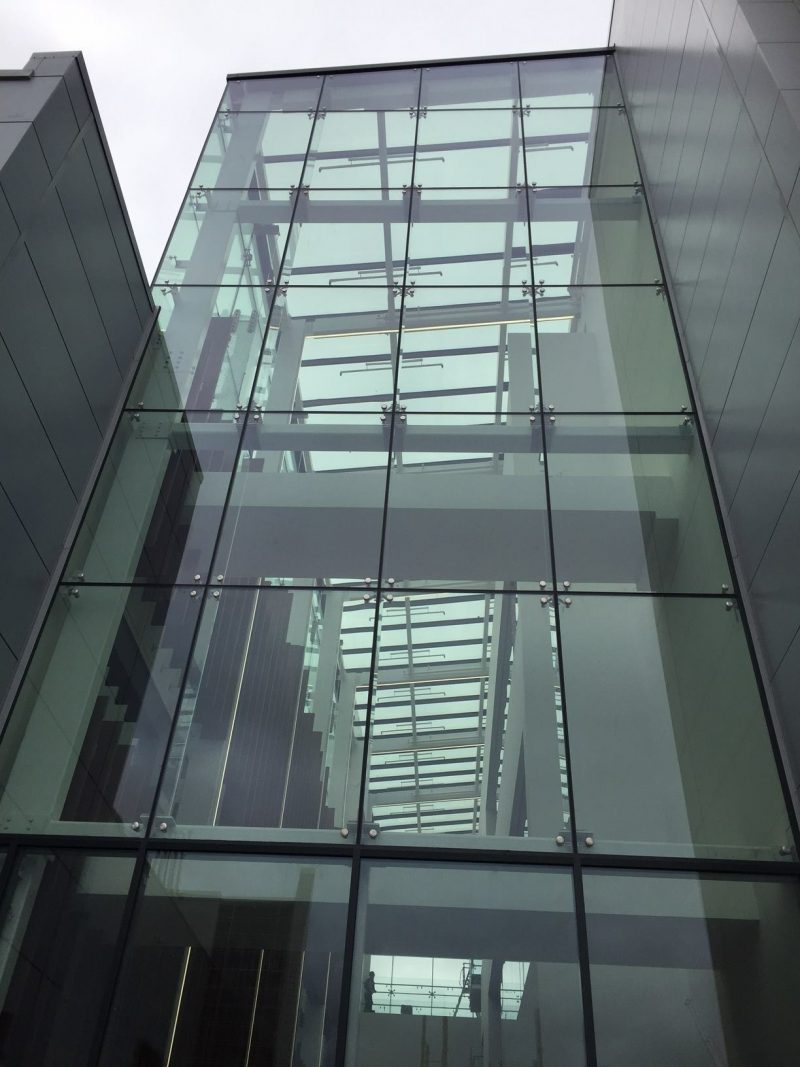
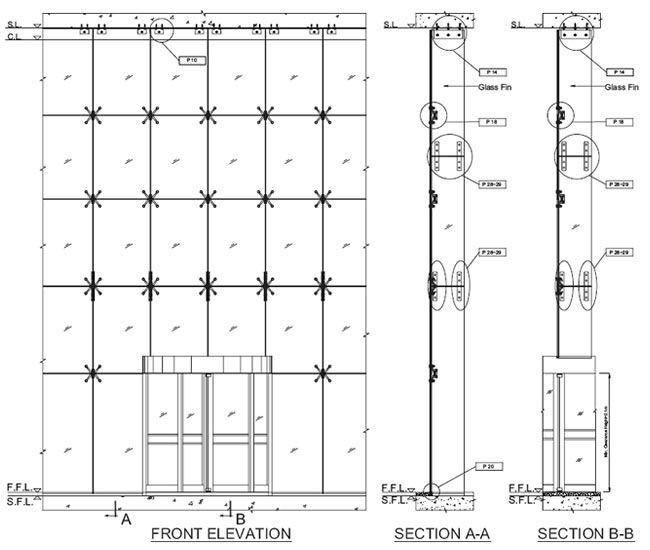
Point Fixed Glazing (PFG), commonly referred to as Spider Glazing, is a high-performance architectural system designed to create maximum transparency in building facades, canopies, and atriums. Unlike traditional curtain walls that rely on continuous aluminum frames (mullions and transoms) to hold glass edges, PFG uses discrete metal fittings to support the glass at specific points.
Core Concept
- The fundamental principle of point fixed glazing is the removal of bulky perimeter framing. The loads (wind pressure and glass weight) are transferred through specialized stainless steel components to a secondary support structure. This results in a “seamless” glass skin that maximizes natural light and offers unobstructed views.
Key Components
- A typical point fixed system consists of four primary elements:
- Glass Panels
Usually tempered or laminated safety glass. Panels are pre-drilled with high-precision holes to accommodate the fixings. - Spider Fittings
Multi-armed (1, 2, 3, or 4-way) stainless steel brackets that connect the glass corners to the support structure. - Routels / Bolts
Articulated or “swivel” bolts that pass through the glass holes. The swivel head allows the glass to flex under wind load, preventing stress concentration. - Support Structure
The skeleton that holds the spiders. This can be steel tubes, glass fins, tension cables, or steel trusses. - Weather Seal
Non-structural silicone sealant applied in the joints between glass panes to ensure the system is water and airtight.
Types of Support Structures
- The visual impact of the system depends heavily on the chosen support:
- Steel Support: The spiders are bolted to a visible steel frame or pipe.
- Glass Fin System: Vertically placed glass “fins” act as the structural support, providing the highest level of transparency (all-glass look).
- Tension Cable/Rod System: A lightweight web of high-strength cables holds the spiders, giving the facade a “floating” appearance.
Technical Advantages
- Maximum Transparency: Eliminates nearly all vertical and horizontal framing members.
- Flexibility: The articulated routels allow the glass to move slightly in response to building sway, thermal expansion, or wind, reducing the risk of breakage.
- Customization: Designers can create complex 3D shapes, curves, and sloped roofs that would be difficult with standard framing.
- Durability: High-grade stainless steel (typically Grade 316) is used to prevent corrosion, making it ideal for high-end commercial entries.