Sliding vs Casement vs Fixed: Choosing the Right Window Type

Why Window Type Matters More Than You Think
When planning windows for your independent house in Ranchi, Nagpur, or Bhubaneswar, most homeowners focus on size and color. But the operating type—sliding, casement, or fixed—significantly impacts daily convenience, performance, cost, and long-term satisfaction.
Choosing the wrong type for specific rooms leads to frustration: windows that don’t provide enough ventilation, interfere with curtains, require too much effort to operate, or don’t seal properly. Getting this decision right ensures decades of comfortable, hassle-free use.
This comprehensive guide compares all window types, helping you select the perfect option for each room in your villa.
The Three Main Window Types Explained
- Sliding Windows (Most Popular in India)
How They Work: Two or more panels (sashes) slide horizontally in tracks. Typically, only one panel moves while others remain fixed, though some designs allow multiple panels to slide.
Common Configurations:
- 2-track system: One fixed, one sliding (50% opening)
- 3-track system: Two sliding, one fixed or all three sliding
- 4-track system: Large openings with multiple sliding panels
- Casement Windows (Best Performance)
How They Work: Windows are hinged on one side and swing open like a door, either inward or outward. Operated by a handle that engages multi-point locks.
Common Configurations:
- Single casement: One panel hinged on left or right
- Double casement: Two panels hinged on opposite sides, meeting in center
- Combination: Fixed panel with casement panel alongside
- Fixed Windows (Maximum Light)
How They Work: Non-operable windows permanently sealed in frame. Glass is fixed directly into frame without any moving parts.
Common Applications:
- Picture windows for views
- High windows for light without ventilation needs
- Combining with operable windows for cost optimization
Detailed Comparison: Sliding Windows
Advantages:
Space Efficiency: No swing space required inside or outside. Perfect for balconies, areas with external grills, or rooms where furniture placement limits swing clearance.
Ease of Operation: Effortless sliding motion requires minimal force. Suitable for elderly family members and children. No risk of windows slamming in wind.
Mosquito Mesh Integration: Mesh easily integrated in sliding track system. Can slide mesh when opening window for ventilation with insect protection.
Cost-Effective: Generally 15-25% less expensive than equivalent casement windows due to simpler hardware requirements.
Familiar Design: Most Indians grew up with sliding windows. The operation is intuitive and comfortable.
Disadvantages:
Limited Opening: Maximum 50% open area (in 2-track systems). Even 3-track systems provide only 66% opening. This limits ventilation compared to full opening of casements.
Air Tightness: Track systems inherently have small gaps. While quality systems minimize this, casements achieve superior sealing. Difference: Class 3 vs Class 4 air permeability.
Acoustic Performance: Sound can leak through track gaps. For noise-critical applications, casements perform 3-5 dB better.
Track Maintenance: Tracks accumulate dust and debris, requiring periodic cleaning. Can become difficult to operate if tracks aren’t maintained.
Water Tightness: Horizontal tracks can accumulate water during heavy rains. Quality systems have drainage, but casements are inherently better.
Best Applications for Sliding Windows:
- Living rooms and family areas (large openings, easy operation)
- Balcony access windows
- Areas with external grills restricting outward swing
- Rooms where furniture placement limits swing space
- Kitchen windows (easy operation while cooking)
- Bathrooms with limited space
- Budget-conscious projects where casements aren’t critical
Cost Range: ₹900-1,500 per sq ft (thermal break systems)
Detailed Comparison: Casement Windows
Advantages:
100% Opening Area: Entire window opens, providing maximum ventilation. In a 4×4 ft window, you get 16 sq ft opening vs 8 sq ft with sliding.
Superior Air Tightness: Compression sealing all around perimeter. Multi-point locks pull sash against frame, compressing gaskets uniformly. Achieves Class 4 air permeability.
Better Acoustic Performance: Perfect sealing translates to 3-5 dB better noise reduction compared to sliding windows with identical glass specifications.
Excellent Water Tightness: No horizontal tracks to accumulate water. Drainage is straightforward with proper gasket design. Achieves higher water tightness classes.
Enhanced Security: Multi-point locking (3-7 points) distributes force, making forced entry extremely difficult. Internal hinges prevent external tampering.
Aesthetic Appeal: Clean lines without visible tracks. Modern architectural preference, especially for contemporary villa designs.
Better Wind Handling: Can be designed with wind stays that control opening angle, preventing slamming in strong winds.
Disadvantages:
Space Requirements: Need clear swing space. Inward-opening interferes with curtains and interior space. Outward-opening requires clearance from grills or exterior obstructions.
Wind Vulnerability: If left open during sudden winds, can slam forcefully potentially damaging hinges or glass. Requires more conscious operation.
Higher Cost: 15-25% more expensive than sliding due to complex hardware (multi-point locks, heavy-duty hinges). Premium hardware adds significant cost.
Operation Force: Requires more effort to operate than sliding, especially in larger sizes. May be challenging for elderly or children, though quality hardware minimizes this.
Mosquito Mesh Challenge: Mesh installation is more complex and expensive. Typically requires separate mesh frame on exterior, adding cost.
Best Applications for Casement Windows:
- Master bedrooms (acoustic priority, air tightness for AC efficiency)
- Children’s study rooms (quiet environment essential)
- Home offices (noise isolation, controlled ventilation)
- Noise-exposed rooms facing busy roads
- Energy efficiency priorities (AC-cooled rooms)
- Premium villa projects emphasizing performance
- Modern architectural designs
Cost Range: ₹1,300-2,000 per sq ft (thermal break systems)
Detailed Comparison: Fixed Windows
Advantages:
Maximum Natural Light: No frame members dividing glass area. Can create expansive glass walls for views and daylighting.
Best Energy Efficiency: No moving parts means perfect sealing. Achieves lowest U-values and best air tightness inherently.
Lowest Cost: Simplest construction, no hardware required. Typically 30-40% less than operable windows of same size.
Highest Acoustic Performance: All four sides permanently sealed. Can achieve maximum noise reduction with appropriate glazing.
Design Flexibility: Can create custom shapes, large sizes, floor-to-ceiling installations impractical with operable windows.
Zero Maintenance: No moving parts to maintain, adjust, or repair. Just glass cleaning required.
Disadvantages:
No Ventilation: Complete lack of air circulation. Must be combined with operable windows or mechanical ventilation.
Cleaning Difficulty: External surface cleaning can be challenging, especially in multi-story applications. Requires exterior access.
Emergency Egress: Cannot be used for emergency exit. Building codes typically require operable windows in bedrooms.
Best Applications for Fixed Windows:
- Staircase landings (light without ventilation needs)
- High clerestory windows for daylight
- Living room feature walls combined with operable windows
- Bathroom privacy windows (small fixed with frosted glass)
- Architectural statements (floor-to-ceiling glass walls)
- Cost optimization (combine with operable windows)
Cost Range: ₹700-1,100 per sq ft (thermal break systems)
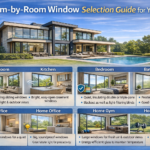
Room-by-Room Recommendations for Your Villa
Master Bedroom (Most Important Decision):
Best Choice: Casement windows Why: Superior air tightness for AC efficiency, better acoustic performance for quiet sleep, excellent security, 100% opening for ventilation when desired Investment: ₹35,000-50,000 for typical 6×5 ft window Alternative: High-quality sliding if budget constrained or space limitations exist
Children’s Bedrooms:
Best Choice: Casement for study rooms, Sliding acceptable for younger children Why: Casement provides quiet study environment. Sliding is safer (no swing slam risk) for young kids Investment: ₹25,000-40,000 per window Consider: Casement if room faces noisy road, sliding if facing quiet courtyard
Living Room:
Best Choice: Combination of fixed and sliding/casement Why: Fixed center panels for views and light, operable side panels for ventilation. Balances aesthetics and function at optimized cost Investment: ₹60,000-1,00,000 for typical large window configuration Design Tip: 60% fixed (center), 40% operable (sides)
Dining Room:
Best Choice: Sliding or casement based on budget Why: Either works well. Prioritize aesthetic coordination with living area Investment: ₹30,000-45,000 Consider: Sliding for cost savings if not noise-critical
Kitchen:
Best Choice: Sliding windows Why: Easy operation while cooking, space-efficient, mesh integration for insect-free ventilation Investment: ₹12,000-18,000 for typical 4×3 ft window Placement: Above platform height (4-5 ft from floor)
Bathrooms:
Best Choice: Fixed or top-hung/awning casement Why: Privacy maintenance, limited space. Top-hung allows ventilation while maintaining privacy Investment: ₹5,000-10,000 per window Glass: Frosted or obscure for privacy
Home Office:
Best Choice: Casement windows Why: Acoustic isolation for video calls, controlled ventilation, air tightness for AC efficiency during work hours Investment: ₹20,000-35,000 Priority: Noise reduction if room faces road
Pooja Room:
Best Choice: Fixed or casement Why: Natural light priority, ventilation secondary. Traditional preferences often favor east-facing windows Investment: ₹8,000-12,000 Aesthetic: Consider decorative glass or traditional designs
Budget Optimization Strategy
For 200 Sq Ft Total Window Area:
Balanced Approach (₹2,80,000 total):
- 30% casement (60 sq ft): Bedrooms, office @ ₹1,600 = ₹96,000
- 50% sliding (100 sq ft): Living, dining, kitchen @ ₹1,200 = ₹1,20,000
- 20% fixed (40 sq ft): Staircase, combinations @ ₹900 = ₹36,000
- Mesh and accessories: ₹28,000
Performance-Focused (₹3,40,000 total):
- 50% casement (100 sq ft): All bedrooms, office, living @ ₹1,800 = ₹1,80,000
- 35% sliding (70 sq ft): Kitchen, utility, balcony @ ₹1,300 = ₹91,000
- 15% fixed (30 sq ft): Design elements @ ₹1,000 = ₹30,000
- Premium mesh and accessories: ₹39,000
Budget-Conscious (₹2,20,000 total):
- 20% casement (40 sq ft): Master bedroom only @ ₹1,400 = ₹56,000
- 60% sliding (120 sq ft): Most rooms @ ₹1,100 = ₹1,32,000
- 20% fixed (40 sq ft): Light-only areas @ ₹800 = ₹32,000
Decision Matrix: Quick Selection Guide
Choose Casement If:
- Room has AC (energy efficiency matters)
- Facing noisy road (acoustic priority)
- Security is concern (ground floor, isolated sides)
- Maximum ventilation needed
- Budget allows premium performance
Choose Sliding If:
- Space constraints prevent swing clearance
- Easy operation priority (elderly, children)
- Budget is tight but quality still desired
- External grills restrict outward opening
- Balcony or limited exterior space
Choose Fixed If:
- Ventilation provided by other windows
- Maximum light and views priority
- Cost optimization opportunity
- High/difficult-to-reach locations
- Architectural feature wall
Making Your Final Decision
Don’t use just one type throughout your villa. Strategic combination optimizes performance, convenience, and cost:
Core Strategy:
- Casement for performance-critical rooms (bedrooms facing roads, AC-cooled spaces)
- Sliding for convenience-priority areas (kitchens, large living areas, balconies)
- Fixed for light-only needs (staircases, design features, combinations)
This balanced approach delivers optimal performance where it matters while managing overall project cost effectively.
Climate-Specific Recommendations
For Guwahati and Bhubaneswar (Heavy Monsoon): Prefer casement windows for superior water tightness in main living areas. Sliding acceptable for sheltered locations.
For Ranchi and Jamshedpur (Industrial Dust): Casement provides better air sealing against dust infiltration. Worth the premium for bedrooms and living areas.
For Nagpur and Patna (Hot Climate): Thermal break is more critical than operation type. Can use sliding in most applications if thermal break specified.
Next Article Preview: Now that you understand window types, our next guide provides room-by-room selection recommendations with specific sizes, features, and budget estimates for your complete villa.