Gaskets vs Sealants in Aluminium Windows
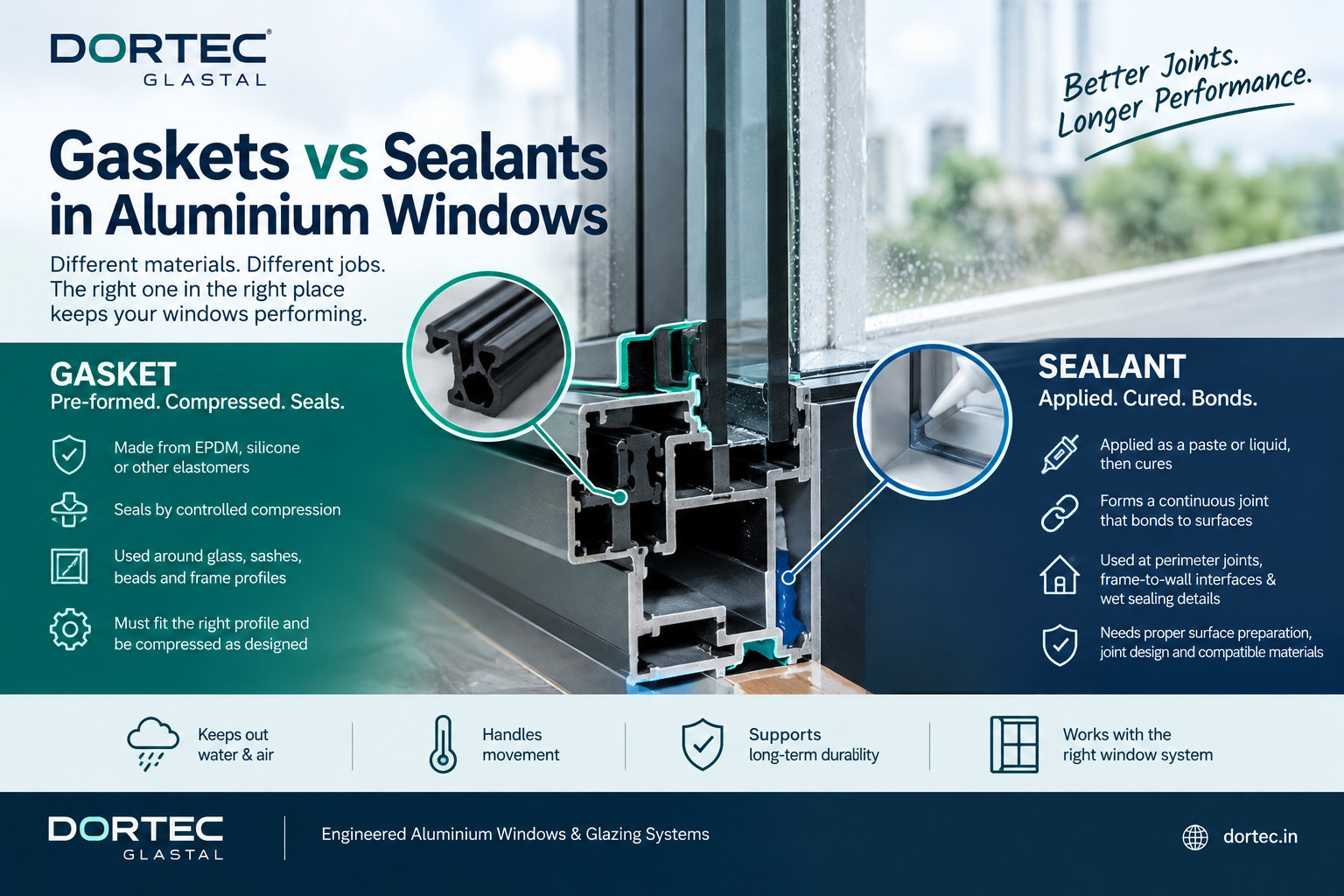
A gasket is a preformed flexible profile that seals through compression. A sealant is applied as a paste or liquid and cures inside the joint. In aluminium windows, both can be important, but they are selected for different locations and movement conditions. Neither can compensate for poor joint design or careless installation.
So, what’s a gasket? It’s a flexible part, made in a fixed profile, that gets fitted into the window system. Usually that means EPDM rubber, silicone rubber or some other elastomer picked for the job. Once it’s in place it’s squeezed between two things, say the glass and the aluminium frame, and that squeeze is what makes the seal.
Because it’s manufactured to a specific shape, a gasket only works properly in the system it was made for. Fit is everything. Too loose and it won’t seal. Squeezed too hard and you get fit problems and a shorter life.
A good gasket does more than seal. It also cushions the glass so it doesn’t sit directly on the aluminium, and it takes up the small movements that come from temperature swings, wind loads and the building itself shifting a little. When it’s fitted well and looked after, it gives a clean, even finish too.
And a sealant? A sealant goes on as a paste or gel, then cures (or otherwise sets) into a continuous seal along a joint. You’ll see it around frame perimeters, at certain joints, and in glazing details that are designed to be sealed wet.
The big difference is that a gasket arrives ready-made and a sealant is made on site, in the joint. So the result depends a lot more on the person doing the work. The product has to suit the materials it touches, the surfaces have to be prepared, the joint has to be the right size, and the sealant needs time to cure. Not every sealant works on every surface or in every glazing detail.
Depending on the system and the specification, a sealant can:
- close joints between materials or around the edge of a frame
- allow for movement, as long as the product and joint were designed for it
- give a continuous seal where wet sealing is called for
- help stop air or water getting through at designated interfaces
Side by side
Aspect Gaskets Sealants
Form A pre-formed part supplied in a set profile. Applied as a paste or compound, then cured or set.
How it seals Usually by controlled compression against By forming a continuous joint that bonds to the surfaces on either side. suitable surfaces, as specified.
Typical role Glazing pockets and designed frame Perimeter joints and details specified for interfaces. wet sealing.
Installation Must go in the correct profile and be Needs proper surface preparation, joint compressed as designed. design and application.
Maintenance Can be inspected and replaced if it’s May need checking and repair or accessible and the system allows. replacement if adhesion or cohesion fails. Main The right profile, material, fit and Compatibility, joint size, adhesion, consideration compression. movement capability and curing.
Neither is better than the other. Each has its own job inside a designed window or facade system, and the specification, the manufacturer’s details and the conditions on site should decide which one you use.
The joint matters more than the material It’s tempting to think a window leaks because the “seal” failed, as though sealing were one simple thing. It isn’t. How a window handles weather depends on the frame design, the drainage and pressure- equalisation paths (where the system has them), the condition of the surface underneath, installation tolerances and the standard of the workmanship.
So a very good gasket can still let you down if it’s twisted, damaged or compressed wrongly. A perfectly suitable sealant can still fail if it goes onto a dirty surface, into the wrong kind of joint, or with no allowance for the movement the joint has to take.
This is also why you can’t swap one for the other. Some systems use gaskets, some use sealants, and some use both in different places. Add sealant where the system doesn’t call for it and you can block drainage or interfere with how the system works. Leave it out where it is needed and the joint is simply unprotected.
Which one do you pick? Start with the window system, not with whatever seems easiest to squeeze out of a tube. Before you specify or replace either one, get clear on a few things: where exactly the joint is and what it’s for; what the system manufacturer’s approved details say; whether the product is compatible with the aluminium finish, the glass, any coatings and the neighbouring materials; how much movement to expect, how
exposed the joint is to sun and weather, and how big it is; and how it will be installed, inspected and maintained.
For new construction, follow the approved system details and the project specification.
Repairs are where people go wrong. If a window is leaking or letting air in, work out where the problem is coming from before you add another layer of sealant. The gap you can see often isn’t where the water gets in, and if you block a drainage path that was put there on purpose, you’ve made things worse.
Mistakes worth avoiding The usual ones: assuming every gasket or sealant suits every aluminium window; choosing a product without checking it works with the frame, glass and surrounding materials; ignoring gasket compression or applying sealant without preparing the surface; and skipping routine inspection, especially at exposed perimeter joints.
The one that bothers me most, though, is using sealant to hide a damaged part or a water problem nobody has properly traced. It looks tidy for a few weeks, and then the problem is back, now harder to find.
In short Gaskets and sealants both protect window joints, but in different ways. A gasket is a pre-formed part that seals by being compressed as designed. A sealant is applied and then cures or sets into a continuous joint. Use the right one in the right place, follow the system details, and make sure the installation is done properly.
The details you can’t easily see are often the ones that decide how a window performs over time.
FAQ
What is the difference between a gasket and a sealant?
A gasket is fitted as a shaped component and works by compression. A sealant is applied into a joint and cures in place.
Where are gaskets used in aluminium windows?
Gaskets are commonly used around glass, sashes, beads, and parts of the frame where a designed compression seal is required.
Where are sealants used?
Sealants are usually used at perimeter joints, frame-to-wall interfaces, and other locations where adhesion and movement capacity are needed.
Can sealant fix a bad window design?
No. Sealant needs correct joint width, depth, surface preparation, and compatible materials to work properly.
Which lasts longer: gasket or sealant?
Service life depends on material quality, exposure, design, and installation. Both need inspection and replacement when they harden, crack, shrink, or detach.