Noise Reduction Windows: What Actually Keeps Outside Noise Out?
Reviewed by Santosh Mishra, Managing Director, Dortec · Last updated 30 October 2026
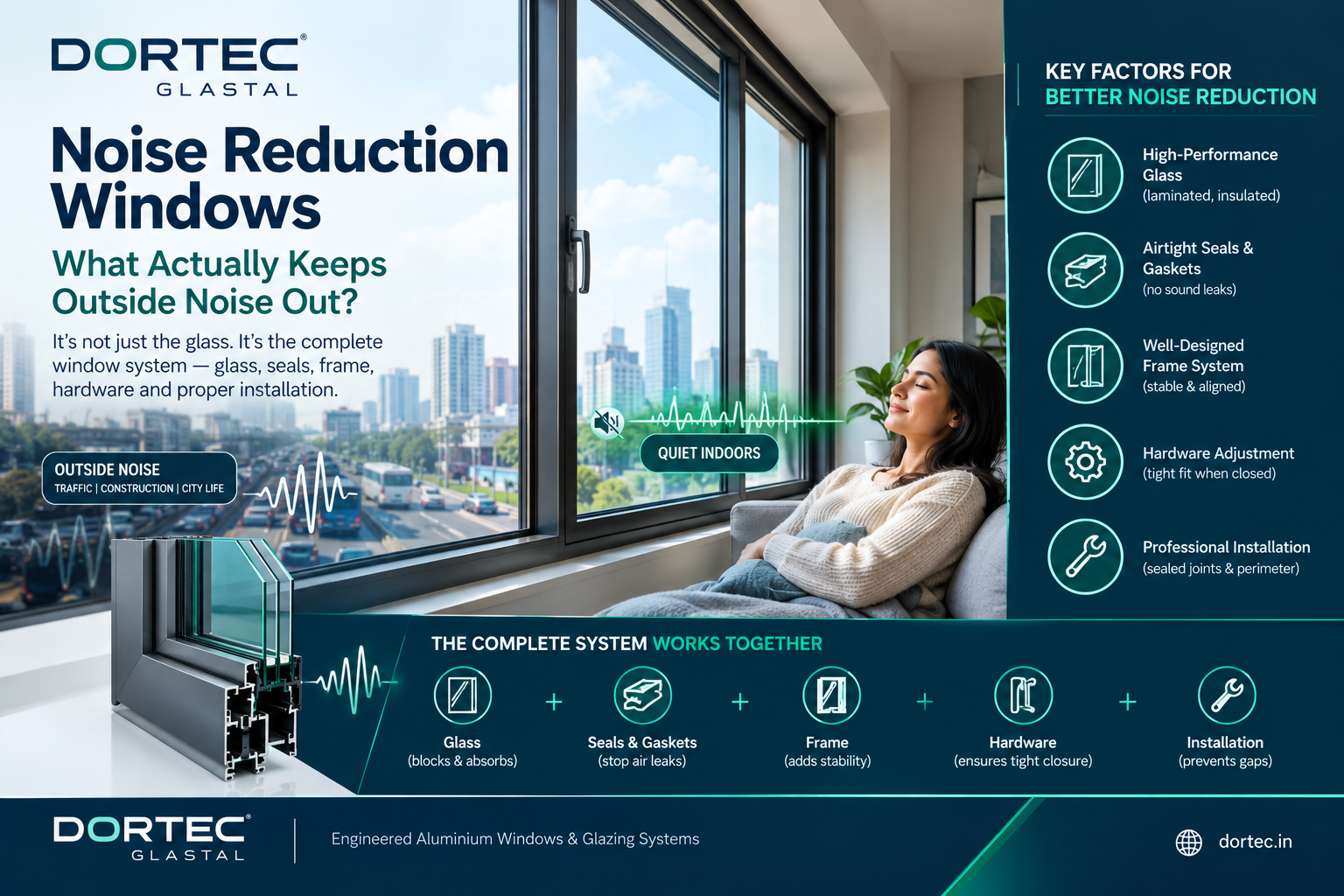
Noise reduction depends on the complete window assembly: glass specification, airtight seals, frame design, hardware adjustment, and installation quality. Thicker glass alone may not solve the issue if air gaps, weak seals, or poor perimeter joints let sound pass through.
Living beside a busy road, near a construction site or on a higher floor of a building can come with one persistent problem: outside noise entering your home. Traffic horns, engines, conversations from the street and sounds from nearby buildings can interrupt sleep, affect concentration and make a room less comfortable. Many homeowners assume that replacing ordinary glass with thicker glass will solve the problem. Others believe that an aluminium window frame itself is responsible for letting noise through. The reality is a little more complicated. A window’s ability to reduce noise depends on several factors working together, including the glass, frame, sealing system, opening mechanism and quality of installation. Improving just one component may not deliver the expected result if sound can still travel through gaps elsewhere. So, if you are planning new windows or looking to improve the acoustic comfort of your home, what should you consider?
1. Why Does Outside Noise Enter Through Windows?
Sound travels through the air as vibrations. When these sound waves reach a window, they cause the glass and other components to vibrate. Some of that sound energy can pass into the room. Noise can also enter through small gaps around the opening panels, seals and joints between the window frame and the wall. This is why even a window with relatively thick glass may perform poorly if it does not close properly or has gaps around its perimeter. Noise may enter through several paths:
- The glass: Sound waves can cause the glazing to vibrate and transmit sound indoors.
- The frame and opening panels: The design and construction of the complete window assembly influence
its acoustic performance.
- Gaskets and seals: Poorly fitted, damaged or deteriorated seals can allow sound to pass through gaps.
- The frame-to-wall joint: Inadequately sealed installation joints may create another path for noise.
- Other building openings: Ventilators, doors, exhaust openings and poorly sealed construction joints can
also contribute to noise entering a room. The first step towards a quieter room is understanding where the sound is coming from rather than immediately replacing the glass.
Are “noise-proof” or “soundproof” windows really soundproof?
Not completely, and it’s worth being wary of anyone who promises that. “Noise-proof” and “soundproof” are everyday words for windows that cut outside noise significantly. In practice, a well-specified acoustic window reduces noise to a level where conversation, sleep and video calls are comfortable, but no window removes sound entirely.
What makes the difference is the complete assembly: laminated acoustic glass or a suitable insulating glass unit, a well-sealed frame, continuous gaskets, good hardware and a properly sealed joint between frame and wall. Acoustic windows are rated by how much sound the whole window reduces, usually as an Rw value (sometimes with a Ctr adjustment for traffic noise). Ask for that figure for the window you are buying, not for the glass alone.
2. Does Thicker Glass Reduce Noise Better?
Glass thickness matters, but it is not the only factor that determines acoustic performance. In general, increasing glass thickness can improve sound insulation under certain conditions. However, the
improvement depends on the glass configuration, the frequency of the noise and the performance of the complete window assembly. For example, traffic noise contains a mixture of low-frequency engine sounds and higher-frequency sounds such as horns. Different glazing configurations respond differently to these frequencies. Simply choosing the thickest glass available does not guarantee the best result. Glass thickness: Heavier glass can improve sound insulation, although the benefit varies with the glazing configuration and sound frequency. Laminated glass: Laminated glass contains layers of glass bonded with an interlayer. Acoustic interlayers designed for sound insulation can improve performance across relevant frequencies, depending on the complete configuration. Insulating glass units (double glazing): These consist of two panes separated by a cavity. They can provide useful acoustic benefits, particularly when the panes have different thicknesses and the cavity is appropriately designed. However, ordinary double glazing does not automatically outperform every single- glazed or laminated configuration for every type of noise. The complete assembly: Glass selection must be matched to the frame, seals, dimensions and installation details. The tested acoustic performance of the complete window is more useful than a glass specification considered in isolation. For buildings exposed to heavy traffic or persistent urban noise, it is worth discussing the actual noise conditions with the window supplier before selecting a glazing configuration.
3. Do Aluminium Window Frames Affect Noise Reduction?
Yes, the frame system plays an important role, but aluminium itself should not automatically be considered the source of the problem. Aluminium is widely used in modern fenestration because it allows slim profiles, durable construction and a range of window designs. Its acoustic performance, however, depends on the design of the complete window system. The frame must hold the glazing securely, maintain the intended alignment and allow the seals to perform correctly when the window is closed. If the opening panels are poorly aligned, the locking mechanism does not pull them firmly into position, or the sealing arrangement is inadequate, sound may pass through the resulting gaps. For this reason, choosing an aluminium window should involve more than comparing profile appearance or dimensions. Ask whether the system is designed to accommodate the required glazing, how it seals around opening panels and whether acoustic test results are available for a comparable window configuration. A well-designed and properly installed aluminium window can contribute to a quieter indoor environment when its glazing and sealing are specified appropriately.
4. Why Window Seals Matter More Than You Might Expect
Imagine installing high-performance acoustic glass but leaving a small gap around the window sash. Sound can still travel through that opening, reducing the benefit of the upgraded glass.
This is where gaskets and seals become important. Gaskets are flexible components fitted between window elements to help create a close-fitting barrier. Depending on the system, they may be used between the glass and frame or around the opening sash. When these seals are correctly selected, fitted and maintained, they help limit air leakage through the window. Since gaps can also provide paths for sound transmission, effective sealing is an important part of acoustic performance. Over time, seals may deteriorate, become displaced or lose their original fit. Hardware adjustments may also be needed if an opening panel no longer closes evenly.
What should homeowners check?
- Look for visible gaps around the closed window.
- Check whether the opening panels close evenly and lock properly.
- Inspect accessible seals for cracks, displacement or deterioration.
- Arrange a professional inspection if noise levels have increased despite the window remaining closed.
Avoid assuming that every noise problem requires new glass. In some cases, correcting a sealing or alignment issue may be an important first step.
5. Sliding vs Casement Windows: Which Is Better for Noise Reduction?
Both sliding and casement windows can provide useful noise reduction windows, but their opening mechanisms influence how they seal. Sliding windows move along tracks. Their acoustic performance depends on the interlocking profiles, brush seals or other weather-sealing arrangements, panel alignment, glazing and installation quality. Casement windows open on hinges. Many systems use compression gaskets that are pressed against the frame when the sash is closed. This can help create an effective seal around the opening panel. However, it would be inaccurate to say that every casement window performs better than every sliding window. A well-engineered sliding system may outperform a poorly designed or incorrectly installed casement system.
When comparing the two, consider:
- The acoustic rating of the complete window assembly.
- The effectiveness of the seals around the closed panels.
- The glazing configuration and frame design.
- The quality of the locking hardware and installation.
- The availability of test results relevant to the intended application.
The better choice is the system that meets the project’s acoustic requirements while also addressing ventilation, space, weather resistance and ease of use.
6. Does Double Glazing Always Mean Better Sound Insulation?
Double glazing can improve sound insulation, but the result depends on how the unit is designed. The air or gas cavity between two panes can help reduce certain forms of sound transmission. However, the two panes, cavity dimensions, glass thicknesses and frame construction all influence the outcome.
Using panes of different thicknesses can help reduce the coincidence effects that may limit sound insulation in some glazing configurations. Laminated acoustic glass may also be worth considering, depending on the noise source and performance target. It is important to distinguish between thermal insulation and acoustic insulation. Double glazing is often selected to improve thermal performance, but a configuration that performs well thermally is not automatically the best option for reducing traffic or other urban noise. If noise reduction windows is the main objective, request acoustic performance data for the proposed glazing and complete window system.
How much noise reduction to expect
Typical reductions by glazing type, with 70 dB of traffic noise outside:
| Glazing | Noise reduction | Inside level | What it feels like |
|---|---|---|---|
| Standard single glazing | 25-28 dB | 42-45 dB | Minimal improvement, still noisy |
| Double glazing (5 mm + 12 mm + 5 mm) | 30-35 dB | 35-40 dB | Comfortable for moderate traffic |
| Acoustic double glazing (6 mm laminated + 14 mm + 4 mm) | 35-40 dB | 30-35 dB | A quiet home environment |
| Premium triple glazing | 45-50 dB | 20-25 dB | Near-silent interior |
Matching the specification to your location
- Moderate traffic (residential areas): double glazing with a 12 mm air gap, thermal break frames and multi-point locking. About ₹1,500-1,800 per sq ft, for a 35-40 dB reduction.
- Heavy traffic (main roads): acoustic laminated double glazing with a 14-16 mm air gap and premium sealing. About ₹1,800-2,200 per sq ft, for a 35-42 dB reduction.
- Extremely noisy (near highways): triple glazing or thick acoustic laminated glass, deep frames and casement windows for the best sealing. About ₹2,200-2,800 per sq ft, for a 45-50 dB reduction.
Prices are indicative and depend on size, glass and hardware.
7. What About Noise in High-Rise Buildings?
Higher floors are not necessarily quieter than lower floors. Depending on the building’s location, surrounding structures and exposure, residents on higher floors may still experience traffic noise, wind-related noise or sounds from nearby buildings and rooftops. The window specification should reflect the actual exposure of the room rather than assumptions based solely on floor level. For high-rise projects, architects and builders should consider the building’s acoustic requirements, the expected noise environment and the performance of the entire external wall assembly. The window-to-wall junction is particularly important. Even a high -performing window may deliver disappointing results if the surrounding installation joint is not adequately sealed. Where acoustic performance is a key requirement, coordination between the architect, facade consultant, window supplier and installation team can help prevent gaps between the specified performance and the finished building.
Which rooms should you prioritise?
If the budget doesn’t stretch to acoustic windows everywhere, start where noise affects you most:
- Master bedroom: usually the most important, because noise disturbs sleep. A road-facing bedroom is the strongest case for acoustic laminated double glazing in a well-sealed casement. About ₹35,000-50,000 for a typical 6×5 ft window.
- Children’s bedrooms: double glazing at minimum, acoustic if the budget allows, for sleep and study. About ₹25,000-35,000 per window.
- Home office: acoustic treatment is essential if you work from home, for clear video calls. About ₹20,000-30,000.
- Living room: acoustic glazing on the road-facing side, standard on quieter sides. About ₹60,000-90,000 for a typical large window area.
- Kitchen: standard windows are usually fine, because ventilation matters more than acoustics here. About ₹12,000-18,000.
Facing matters too: one road-facing elevation may need a very different specification from the rest of the home.
8. How Can You Choose the Right Noise Reduction Window?
Before selecting a window system, begin by identifying the problem you want to solve. Is the main concern traffic noise, horns, construction activity, voices from neighbouring properties or a combination of sources? The answer can influence the glazing and window configuration required.
1. Identify the noise source. Different sources produce different sound frequencies, so understanding the
environment helps guide the specification.
2. Ask for acoustic test results. Look for the sound reduction rating of the complete window assembly, not
just the glass. Depending on the test standard, relevant ratings may include Rw and applicable traffic-noise adaptation terms such as Ctr. Be cautious of vague promises such as “completely soundproof” or a “noise-proof guarantee” without test data. Also ask how many locking points the opening panel has, because firm, even compression on the gaskets is part of what keeps sound out.
3. Compare glazing configurations. Ask whether laminated acoustic glass, different pane thicknesses or
insulating glass units are appropriate for the specific noise conditions.
4. Check the sealing system. Confirm how the window seals around opening panels and at the perimeter.
5. Review installation details. The joint between the frame and wall must be designed and sealed
appropriately.
6. Consider other sound paths. If noise can enter through ventilation openings, doors or other parts of the
building envelope, replacing the windows alone may not solve the entire problem.
A properly specified window system should be selected on the basis of measurable performance and the needs of the building, not simply on the thickness of the glass or the appearance of the frame.
Two Dortec projects
A house on a main road in Patna
Before: 75 dB of traffic noise. The family couldn’t sleep with the windows closed because the rooms felt stuffy, or with them open because of the noise.
Solution: acoustic double glazing (6 mm laminated + 14 mm + 5 mm) in casement windows for the bedrooms.
After: 32 dB inside, with comfortable sleep, windows closed and the AC running efficiently. The investment was ₹55,000 for three bedroom windows.
A villa next to a highway in Nagpur
Before: 78 dB of highway noise. The children struggled with online classes and the family had constant headaches.
Solution: triple glazing for the rooms facing the highway and acoustic double glazing on the other sides.
After: 28 dB in the bedrooms facing the highway and a normal home environment. The investment was ₹1,80,000 across 180 sq ft of windows. Working from home became practical, and the property value rose by 8-10%.
Measure it yourself
A free decibel-meter app on your phone is enough. Measure inside and outside with the windows closed before installation, then again in the same spots afterwards. Premium acoustic windows should show a 35-42 dB reduction, even on a basic app. Keep the readings for your warranty records.
The Dortec Perspective
At Dortec Glastal, that good fenestration is about more than appearance. Windows should be selected to support the comfort, functionality and performance requirements. When noise reduction is a priority, the glass, aluminium profile system, gaskets, hardware and installation details must be considered together. Each component contributes to how the complete window performs. For homeowners, architects and builders, the most useful question is not simply, “Which glass is the thickest?” It is, “Which complete window system is suitable for the noise conditions of this building?” A quieter indoor environment begins with the right diagnosis, a considered specification and careful installation. The takeaway: Effective noise reduction does not depend on glass alone. The glazing, frame, seals and installation must work together to limit sound transmission. Before upgrading your windows, identify the source of the noise and compare the acoustic performance of complete window systems. A quieter home starts with the right window system-not just thicker glass.
Based in Kolkata? Hear the difference for yourself at our Salt Lake Experience Centre. Read more about our aluminium windows in Kolkata.
FAQ
Does thicker glass reduce noise?
It can help, but only as part of a complete acoustic window assembly. Gaps and air leakage can reduce the benefit.
Is laminated glass good for noise reduction?
Laminated glass can improve acoustic performance, especially when specified with the right interlayer and system design.
Do aluminium windows block noise?
They can, if the window system has suitable glass, seals, hardware, and installation details.
Why does sound still enter after changing glass?
Sound may be entering through gaps around the frame, poor seals, vents, thin walls, or other weak points in the room.
What should I ask before buying acoustic windows?
Ask for the full system specification, glass details, sealing approach, installation scope, and any test data available for the proposed assembly.
Are noise-proof windows worth it in Kolkata?
For bedrooms and rooms facing busy roads, usually yes. Traffic, horns and construction noise are common, and a well-sealed acoustic window can make those rooms far more comfortable. For quiet sides of the home, standard glazing is often enough.