Thermal Break Aluminium Windows: Are They Worth It in Indian Weather?
Reviewed by Santosh Mishra, Managing Director, Dortec · Last updated 30 October 2026
Thermal break aluminium windows reduce heat transfer through the frame by separating the inner and outer aluminium sections with a lower-conductivity material. They are most useful in air-conditioned spaces, sun-exposed elevations, and projects with large glazed openings. They do not replace good glass, shading, airtightness, or proper weather sealing.
Aluminium windows have caught on in homes and commercial buildings alike. The frames are slim, they look modern, they last, and they can carry big sheets of glass. But one worry keeps coming up, especially through India’s hot summers: how much heat comes through an aluminium frame?
That’s where thermal-break technology comes in.
Maybe you’ve noticed a room heating up even with the windows shut, or your air conditioner struggling through the afternoon. The glazing and the window frame are worth a look there, alongside the building’s insulation and shading.
Thermal-break windows are designed to cut heat transfer through the frame. But does every Indian home need them? And do they make a noticeable difference in rooms with large glass openings? Let’s go through how they work and when they’re worth considering.
1. What is a thermal break?
Aluminium is strong, light and durable. It also conducts heat quite easily.
In a conventional aluminium window, the metal profile gives heat a direct path from the hotter side of the frame to the cooler side. In summer, that can mean heat finding its way into an air-conditioned room.
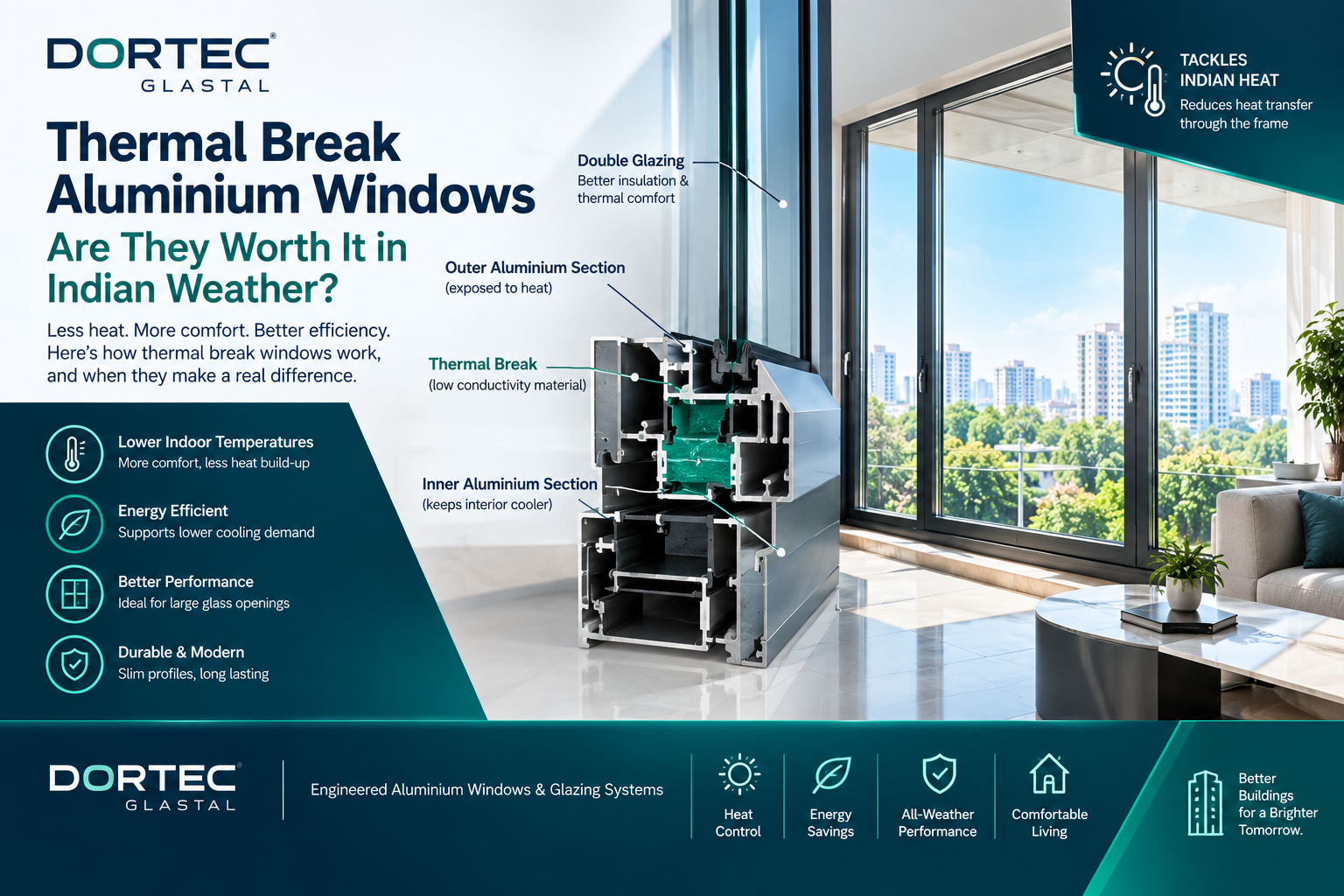
A thermal-break window deals with this by splitting the profile in two, an inner aluminium section and an outer one, and joining them with a material that conducts far less heat. That separating piece is commonly a reinforced polyamide strip, though materials and construction vary from system to system.
The outer section can still get hot in the sun. The break just makes it harder for that heat to travel straight through the frame to the inside.
One thing to be clear about: a thermal break aluminium windows doesn’t stop heat transfer altogether. It reduces one of the routes heat takes across the window.
2. Why it matters in India
India covers a huge range of climates: hot, dry summers, humid coasts, heavy monsoon rain, and cooler winters in some regions. In a city like Kolkata, with high summer temperatures, humidity and regular air-conditioning, indoor comfort is a real consideration.
Big windows bring in light and views, but how they perform thermally depends on several things. Solar radiation passes through the glass, and heat also conducts through the frame. A conventional aluminium frame may let more heat through than a comparable thermally broken one, so reducing it can improve the overall performance of a suitable window system.
It’s most relevant when a building runs air conditioning for long stretches, when windows get strong direct sun for several hours, when the design has large glazed openings, when indoor comfort and energy efficiency are priorities, or when the specification asks for better insulation.
Still, a thermal break doesn’t solve overheating on its own. Solar control glass, external shading, sensible window orientation and a well-designed building envelope all still matter.
3. How a thermal-break window works
The idea is simple: cut the direct metal path that heat conducts along.
In a conventional window, the inner and outer parts of the frame are joined by aluminium, which passes heat on readily. In a thermally broken system, an insulating strip sits between the two sections. Less heat flows through the frame, so the interior profile is less affected by the outdoor temperature than it would be in a comparable system without a break.
How much better it gets depends on the profile design, the break material, the width and shape of the insulating section, and the full window configuration.
And a window is more than its frame. The glass, spacers, gaskets and installation joints all affect thermal performance too. A well-designed thermal break can improve the frame’s insulation, but you have to look at the complete assembly to know what it does for the building.
4. Thermal-break vs conventional aluminium
Both can be the right choice, depending on the project. The difference is in how they handle heat transfer through the frame.
Feature Conventional aluminium windows Thermal-break aluminium windows Frame construction Aluminium sections with no Aluminium sections separated by a dedicated insulating break low-conductivity component Heat transfer Generally higher Reduced by the thermal break through the frame Indoor thermal Depends on the complete window Can improve when frame heat comfort and building design transfer is a significant factor Air-conditioning Depends on glazing, shading, May help reduce cooling demand efficiency airtightness and other factors when the overall system is better insulated
Feature Conventional aluminium windows Thermal-break aluminium windows Condensation risk Can be higher on cold interior frame Can reduce the risk on cold interior surfaces under suitable conditions frame surfaces, depending on humidity and system design Initial cost Often lower Generally higher, depending on the system and specification Best application Projects where the required Projects that put a priority on better performance can be met frame insulation and overall thermal economically without a thermal performance break
Compare actual products and specifications, not categories. Not every thermal-break window beats every conventional one in every respect. Glazing quality, weather seals, frame geometry and installation can all change the result significantly.
5. Will it cut your AC bill?
It can contribute to lower cooling demand, but how much you save depends on the building and how it’s used.
Picture a room that gets strong afternoon sun and runs the air conditioner for several hours every day. Heat coming through the windows adds to the cooling load. A thermally broken frame cuts the share of that heat that travels through the frame itself. Over time, less heat gain can help the cooling system work more efficiently and keep the room comfortable.
The size of the benefit depends on a handful of things:
- Window area. With large windows, the thermal performance of the whole assembly matters
more.
- Sun exposure. Windows in direct sunlight see higher heat gains.
- Glass specification. Solar heat coming through the glass may matter more than heat through the
frame.
- External shades, overhangs and similar measures cut the solar heat reaching the glass.
- Air leakage. Gaps around the window let unwanted outdoor air in.
- How often you cool. The benefit is mostly relevant in buildings that need frequent cooling.
So treat a thermal break as one piece of an energy-efficiency plan, not a promise of any particular drop in your electricity bill. If you want a meaningful comparison, ask for the thermal performance values of the complete window systems being proposed and weigh them against the project’s cooling needs.
Typical figures: U-values, savings and payback
U-values show how much heat passes through a window. Lower numbers mean better insulation. Typical values:
| Window type | Typical U-value (W/m²·K) |
|---|---|
| Regular aluminium window | 5.5-6.5 |
| Thermal break window (single glass) | 2.5-3.5 |
| Thermal break + double glazing | 1.2-1.8 |
The thermal break alone reduces heat transfer through the window by 50-60%. Combined with double glazing, the reduction is 75-80% compared with standard windows.
An example: a 2,000 sq ft house in Bhubaneswar
Take an independent house with 200 sq ft of windows (about 10% of the built-up area), air conditioning running 10 hours a day from April to September, and electricity at ₹8 per unit.
- With regular windows: about ₹5,500-6,500 a month for AC, or ₹33,000-39,000 for the summer.
- With thermal break windows: heat gain is about 40% lower and the AC runs shorter cycles, at about ₹3,500-4,200 a month, or ₹21,000-25,200 for the summer.
- Saving: about ₹12,000-14,000 a year, or ₹3,00,000-3,50,000 over 25 years.
What the premium costs and when it pays back
Thermal break windows cost about ₹300-600 more per sq ft than regular aluminium:
| System | Indicative price per sq ft |
|---|---|
| Regular aluminium sliding | ₹700-900 |
| Thermal break sliding | ₹1,000-1,500 |
| Regular casement | ₹900-1,100 |
| Thermal break casement | ₹1,300-1,900 |
For 200 sq ft of windows, the premium is about ₹60,000-1,20,000. With annual savings of ₹12,000-14,000, that is recovered in 4-9 years, and the windows typically last 40+ years. Final prices depend on size, glass, hardware and site conditions.
Where a thermal break matters most
- Must-have: master bedroom (where the AC runs longest), children’s bedrooms, a south- or west-facing living room, and any room with AC running 4+ hours a day.
- Optional: kitchens (usually not air-conditioned), utility areas and north-facing rooms with good natural shade.
A practical approach is to use thermal break windows for the 60-70% of the house that is air-conditioned, and standard quality windows elsewhere.
6. Large glass windows and sliding doors
Big, glazed openings are everywhere now, in residences, offices and premium developments. They make interiors feel open, bring in daylight and link rooms to balconies or views. They also raise the stakes on getting the glazing and frame system right.
A thermal-break aluminium system is worth considering where large windows are part of an air-conditioned space, especially if the building gets a lot of sun. That doesn’t mean every large window must have one. Think about the ratio of frame to glass, the glazing performance, the orientation, the shading and the energy performance you need.
Say a window has a small frame but takes intense direct sun across a big pane of glass. There, the solar heat coming through the glass is probably the bigger problem, and good solar-control glazing and external shading can matter as much as, or more than, improving the frame’s insulation.
The best solution looks at the whole opening, not at one component.
7. Does it help in the monsoon?
Not directly. A thermal break deals with heat moving through the frame. It isn’t a waterproofing or weatherproofing feature.
In the monsoon, how a window performs comes down to the weather seals, drainage, hardware, frame design and installation details. A thermally broken window can be designed to resist weather well, but the break by itself doesn’t protect you from wind-driven rain or leaks.
If you’re choosing windows in a city like Kolkata, check the system’s water-tightness performance under suitable test conditions; the design and condition of its gaskets and weather seals; the drainage provisions and how water is sent back outside; the quality of the frame-to-wall sealing and installation; and whether the system suits the wind and rain the building will face.
Thermal performance and weather resistance both reflect the overall quality of a window system, but they’re separate requirements and should be judged separately.
8. Condensation
Condensation happens when a surface gets cold enough that moisture in the surrounding air turns to liquid water. In an air-conditioned room, the inner side of a window frame can run cool, and if its surface temperature drops below the dew point of the indoor air, condensation can form.
A thermal break reduces heat transfer between the outer and inner aluminium sections, which under suitable conditions keeps the interior frame surface warmer and makes condensation less likely. That can help in a humid climate, where indoor moisture levels may be high.
It won’t remove condensation in every situation, though. Indoor humidity, air-conditioning settings, glazing temperature, ventilation and the design of the whole window all affect the outcome. If condensation keeps coming back, look at the indoor humidity and the thermal performance of the entire window, not just the frame.
9. How to choose one the best system isn’t automatically the one with the thickest profile or the highest price. It’s the one that meets what the building needs. Here’s what to look at.
1. Ask for thermal performance data. Request the U-value of the complete window assembly where it’s available. A lower U-value generally means less heat transfer through the assembly under the stated test or calculation conditions.
2. Look at the glass separately. Ask about its solar heat gain coefficient (SHGC) and light transmission where relevant. These show how much solar heat and visible light pass through.
3. Check the thermal-break design, and ask to see it. Find out what insulating material is used and whether the system is designed for your application.
A reputable supplier should be able to show you:
- A cut cross-section of the profile, so you can see the insulating strip separating the inner and outer aluminium.
- The strip material. Look for polyamide with 25-30% glass-fibre reinforcement, which insulates while staying strong and stable.
- The width of the break. A minimum of 14-18 mm gives good insulation. Ask for the actual dimension in your system rather than a description.
- The profile depth. Deeper profiles (60-70 mm) generally perform better, as they leave more room for insulation and better seals.
- A documented U-value for the complete window, not a figure for the strip or the glass alone.
If a supplier can’t explain or show these details, treat the thermal-break claim with caution.
4. Think about size and orientation. A west-facing window in strong afternoon sun may need a different glazing and shading combination from a shaded opening facing another way.
5. Review weather and air-leakage performance. Insulation is only one part of the picture. Air permeability, watertightness and wind-load performance matter too.
6. Assess the installation. Poorly sealed joints can undo the benefit of an otherwise well-designed window.
7. Weigh the extra cost against the benefit. The value of a thermal break depends on the climate, the building’s cooling needs, the glazing specification and the project’s long-term goals.
For architects, developers and homeowners, the most reliable approach is to compare documented specifications and not to go by product labels alone.
The Dortec perspective
At Dortec Glastal, we think the right window starts with understanding how the building will be used and what conditions it must perform in.
Thermal-break aluminium windows can be a valuable choice where cutting heat transfer through the frame matters. But good fenestration needs a wider view that treats the profiles, glazing, seals, hardware and installation as one system.
For premium residences, large glass openings and air-conditioned spaces, the right mix of thermal-break technology, solar-control glazing and suitable shading can make the indoors more comfortable. The
decision should follow the project’s real requirements, backed by reliable performance data and careful installation.
In short: thermal-break aluminium windows can reduce heat transfer through the frame, but their real value depends on the complete window system and the building. Before you invest, look at the glazing, the sun exposure, your air-conditioning needs and the overall thermal performance together.
Based in Kolkata? See the systems at our Salt Lake Experience Centre. Read more about our aluminium windows in Kolkata.
FAQ
What is a thermal break in aluminium windows?
It is a low-conductivity section placed between the inner and outer aluminium profiles to reduce heat flow through the frame.
Do thermal break windows reduce AC bills?
They can contribute to lower cooling demand, but savings depend on glass, shading, orientation, window area, air leakage, and usage.
Are thermal break windows needed in Kolkata?
They are worth considering for air-conditioned rooms, large windows, and sun-exposed elevations, but the whole window specification should be reviewed.
Do thermal break windows stop monsoon leakage?
No. Leakage control depends on seals, drainage, frame design, perimeter joints, and installation.
What should I compare before paying extra?
Compare complete system performance, glass specification, frame design, warranty, installation scope, and the project climate conditions.